From Two Halves to Four Quarters: The Shape of Game Time
Game time in halves or quarters shapes when play pauses and how a match reaches its finish. Learn to read the clock, intervals and restarts clearly.
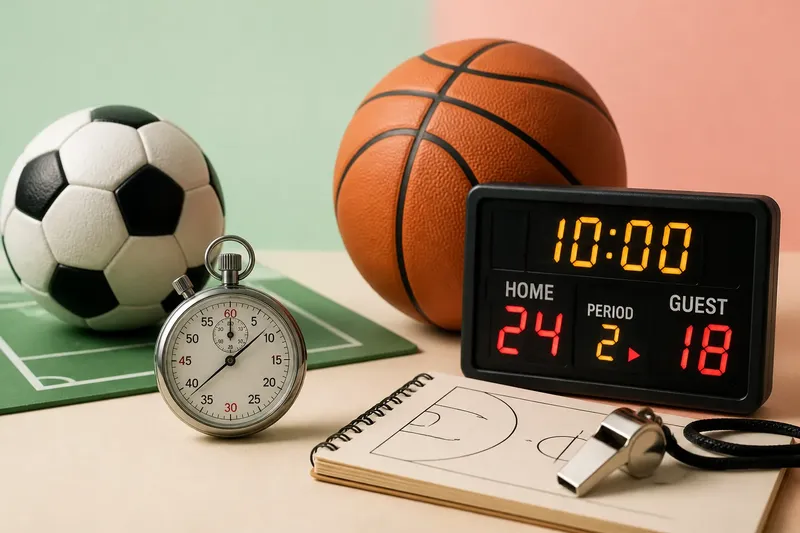
Why does football divide play into two halves while basketball uses quarters, and how can you tell what a stopped clock means? Game time in halves or quarters gives a match its structure, but the clock rules decide whether a pause changes the time shown, the period, or both.
Period structure
A half is one of two main playing periods, separated by an interval. Association football offers a familiar example: play runs through the first half, pauses at half-time, then resumes for the second. Quarters divide a contest into four periods, with breaks between them and a larger interval at the midpoint in many formats.
The difference is more than the number of labels. A half-based format gives each main stretch a longer arc before the central break. Quarters create more formal boundaries within the match. But the structure alone does not tell you how much active play fits into each period: that depends on the sport’s clock rules and stoppages.
Halves and quarters
In football, the half-time interval is a prominent point for players to recover and coaches to talk through what has happened. The main change of phase comes at the midpoint, although ordinary stoppages can occur at any time. A displayed clock may also be accompanied by added time, depending on the competition’s rules.
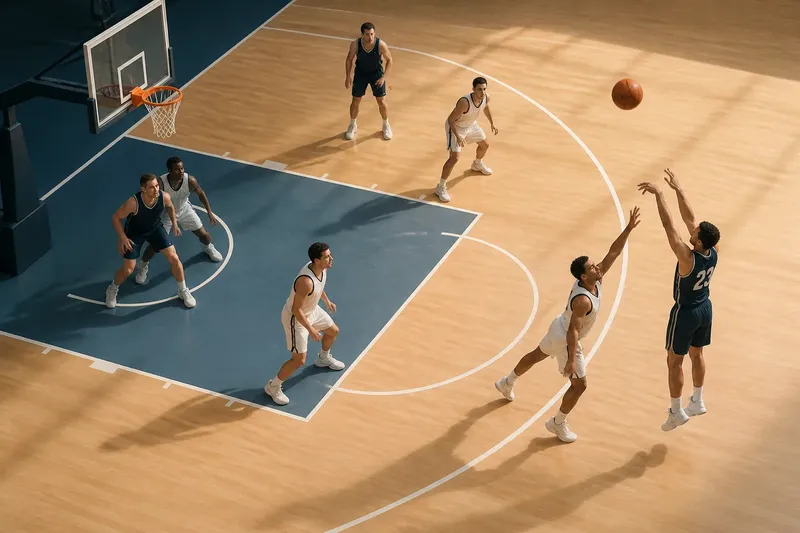
Basketball’s quarters provide more frequent period boundaries. The clock commonly stops for defined events, and time-outs can add further pauses. The exact procedures vary by competition, so a quarter’s end is best understood as a formal boundary rather than a promise that the period has contained a fixed amount of uninterrupted action.
These formats create different viewing rhythms, but neither is automatically quicker or more tactical. To compare them, notice where the official period breaks fall and how the clock behaves between them. That is more useful than assuming that a half in one sport works exactly like a half in another.
Clock behaviour
A match clock may keep running through many interruptions, stop for specified events, or combine both approaches. In football, the displayed time usually advances through ordinary pauses, with the referee accounting for interruptions through added time. In basketball, the clock is stopped for defined situations, including certain dead-ball moments. Always check the rules of the competition you are watching.
At the end of a period, the display reaching its final mark does not always settle whether the match is over. Added time or stoppage time extends a period to account for interruptions; extra time or overtime usually means additional play under a format that needs to resolve a tie. The terms and procedures differ across sports and competitions.
Breaks and restarts
A period break is not the same as every pause in play. An injury stoppage, review, timeout or boundary decision may interrupt action without starting a new period. The restart then follows the sport’s rules: play might resume from a particular location, with a set possession, or through another prescribed action.
When a period does end, note whether teams change ends, which side begins with possession, and whether the clock restarts immediately. Those details can make the opening of a new period look different from an ordinary resumption. They also help explain why two pauses of similar length can have different consequences for the match.
What do viewers ask?
Does the clock stop in football?
In association football, the clock generally continues through many routine interruptions, while the referee allows for time lost at the end of the half. Check the competition’s rules for the precise handling of added time and any special procedures.
Does the clock stop in basketball?
Basketball stops the clock for specific events, though the exact rules vary by league and competition. Watch the official’s signal and the scoreboard rather than assuming every whistle affects the clock in the same way.
What is the difference between added time and extra time?
Added time extends a period to account for interruptions within it. Extra time is additional play used in some formats when a tie must be resolved; a competition may instead allow a draw or use another deciding procedure.
Does every break start a new period?
No. A timeout, review or injury stoppage can pause play within the same period. Check the scoreboard and the officials’ restart signal to see whether the period has changed.
Reading the clock
Say you are watching an invented football match: the first half reaches its displayed final minute, play pauses for an injury, and the referee signals added time. The display continues beyond the usual period mark, but the teams remain in the first half until the referee ends it. At half-time, they leave the field; after the interval, the second half begins. The useful distinction is between time added within a period and a new period starting.
For a first viewing, keep these questions in mind:
- Check whether the clock keeps running after a routine whistle; if it does, expect the period to continue on the display, otherwise wait for the official restart.
- Check whether the scoreboard labels the current period; if the label changes, treat play as a new period, otherwise assume the same period continues.
- Check whether officials announce added time; if they do, expect play to continue within that period, otherwise follow the ordinary period-ending signal.
- Check whether a tied score leads to extra time under the competition rules; if it does, expect another playing period, otherwise look for the stated alternative, such as a draw or another deciding procedure.
- Check whether the break is a timeout or an interval; if it is a timeout, expect play to resume within the period, otherwise look for the period’s formal restart.
- Check the restart signal and possession or starting position; if the prescribed setup changes, follow the new period’s opening, otherwise watch for continuation from the stoppage point.
Understanding game time in halves or quarters makes it easier to follow what a scoreboard can and cannot tell you. The most useful detail is often the small one: whether a pause merely interrupts play, extends a period, or marks the start of another.